Saturday, May 19, 2012

Food adventures in Seoul

1. Sannakji

One of the best places in Seoul for seafood is outside the Noryangjin subway station, south of the river. Cross the overpass and descend into the auction market, where you'll find several restaurants. You can order off the menu or bring your own food and they'll cook it for you. I'm not certain of the name of this place. "Red Fish," maybe?


Here I tried the live octopus, or sannakji. The tentacles' suction cups grab the inside of your mouth. I almost choked once because they wouldn't let go of my throat and had to kinda cough it back onto my tongue. You really have to pulverize these suckers to make 'em cry uncle, like the Hulk rag-dolling Loki.

They don't taste like much, essentially taking on whatever flavor sauce you dip them in, and they're fiendishly difficult to pick up with the stainless-steel chopsticks they use in Korea. I found it easiest to pick them up with my fingers and place them on a sharp-tasting leaf, along with a little spicy garlic sauce, some hot pepper, raw garlic and a dash of sesame oil. Dip this little leafy burrito into a soy-wasabi mixture, and eat it all in one mouthful.

sannakji from Sluggh McGee on Vimeo.


2. Jokbal

Walk in the same direction of the stairway at Exit 3 of the Dongguk University subway station and you'll encounter about a dozen jokbal restaurants on the right side of the street. Each, seemingly, has a picture of an elderly proprietress claiming her pigs feet to be the most original. I randomly picked this place. I think the translation is "Jokbal Place." Catchy.


These richly marinated trotters, to use the euphemistic term, are boiled for hours, then thinly sliced and eaten wrapped in lettuce leaves. They're rich in collagen and supposedly give you a youthful appearance. As long as I don't wind up looking like Melanie Griffith, I'm cool.

One of the great things about Korea is that the many side dishes you're given at every meal can be endlessly replenished for no cost. One of the more remarkable things I've tasted during my visit was this clear, cold soup with bits of turnip at the bottom. It has the savoriness of a meat product with a citrusy undertone. Ice chips float in it. I still don't know what it's called.


The dipping sauces at this place are highly fermented. One bowl of red sauce is made from rotten shrimp, the other from ... I don't know what -- human flesh? Honestly, it's what I imagine eating a corpse would be like. An acquired taste, to be sure, but I gave it my best shot.


I got here at 6:45 p.m. -- just in time. A few minutes later there was a line out the door. Many of the waitresses and kitchen staff are ethnic Korean citizens of China. They can earn a lot more here than they can back home. Sounds familiar to this Arizonan. They send money to their families in the hopes of one day returning to China and owning their own home.

jokbal from Sluggh McGee on Vimeo.


Tip: Unless you're out for pizza, fried chicken or a bowl of noodles, solo dining in Seoul is almost unheard of (Seongbuk-dong's "taxi driver restaurants," or gisa sikdang, being an exception). Some of the more traditional restaurants don't think it's worth laying out all the side dishes and firing up a charcoal grill for just one person, and they may politely (or not so politely) suggest you go down the street.

Don't get discouraged! Keep trying and you'll eventually be shown a chair or a pillow on the floor. You will inevitably order too much food, but every place I've been to is happy to wrap up the leftovers. I still have some jokbal in my fridge. And don't overlook the fried chicken in Seoul. The seasonings are out of this world.

The Seoul Museum of History

"The past is a foreign country: 
They do things differently there."
L.P. Hartley, "The Go-Between"


I've been skipping the palaces and other Joseon Dynasty jive. Forgive me, Korea, but I yam what I yam! At the Seoul Museum of History is a great temporary exhibit, "Seoul in Turbulence, as Seen by the AP."


If you're anywhere in East Asia, you may wish to check it out. If you're not, I'll save you a trip. The Euljiro area of Seoul on June 28, 1950, just before the city was occupied by the North Korean army.  


The attack was an utter surprise. One million people who couldn't get out in time were forced to live under North Korean control for 90 days until Seoul was briefly retaken.

By December, Seoulites were on the run again. Nearly a million would flee as North Korean and Chinese forces reoccupied the city. On Sept. 1, 1950, a crowd gathered around an exhausted U.S. soldier.


Children and their mothers covered their ears as they watched cannon fire on Sept. 24, 1950. 


By Sept. 28, 1950, the city was in ruins.


American soldiers took Communion on the steps of the Capitol building after a fierce battle on Oct. 3, 1950.


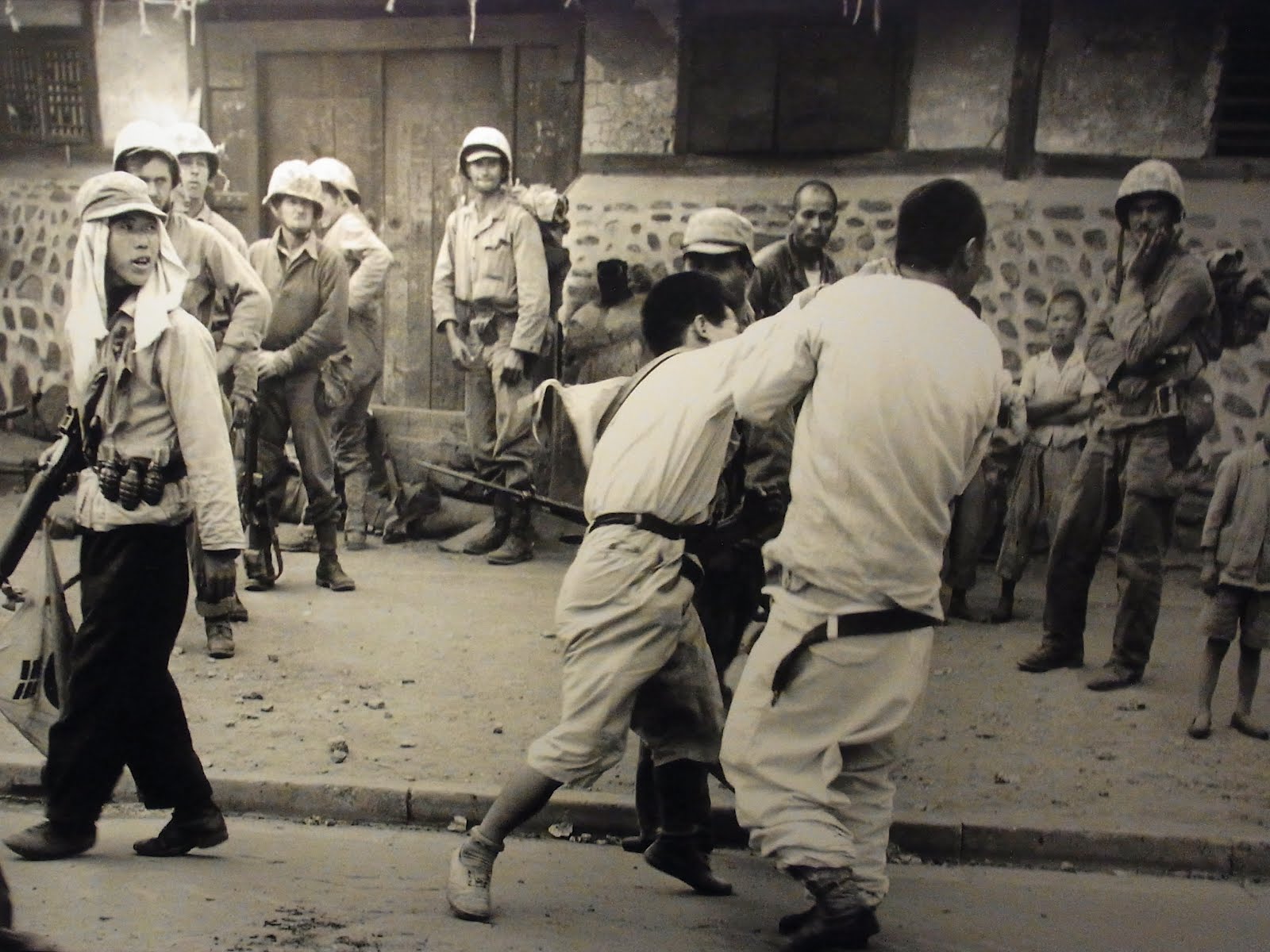
Citizens were divided into anti-Communists and North Korean sympathizers, and they feuded fiercely.  


A Seoulite kicks a North Korean POW. 


Refugees stream south after Seoul's recapture by the North.


Ike visited in December 1952. A banner welcomed him on the Capitol building. 


After the war, North Korean prisoners who refused to return to the North were treated like heroes at Seoul Railway Station. 


Things stayed hairy after the war. There were rigged elections and crackdowns on personal liberties, and Seoulites rose up, kicking out the so-called Liberal Party. 


Kids on homemade sleds play on the frozen Han River. This photo was taken in February 1959 when Sluggh was exactly 1 week old.


Seoul in 1960.


"Seoul in Turbulence, as Seen by the AP" 
Through June 3 at the Seoul Museum of History
9-9 weekdays, 9-7 weekends
Closed Mondays
Gwanghwmun Station Exit 7 
(next to the Salvation Army building) 
Admission is free.


Friday, May 18, 2012

Language lessons


On occasion, strangers will approach me in Seoul and ask for English tips. They know more English than I know Korean, so I'm happy for the chance to learn from them. People seem really interested in these conversations. They will move closer and stare. From today alone:

Korean: Hello.

Sluggh: Hello.

Korean: To say "agony" as it affects you. How?

Sluggh: I am in agony.

Korean: I am agony.

Sluggh: [Cupping left hand, pointing to my chest and then jabbing the cup] I am IN agony. Physical or mental torment.

Korean: Toh-ment?

Sluggh: Pain.

Korean: Ah. Thanking you.

* * *

Korean: Hello.

Sluggh: Hello.

Korean: How do you say, "I am a good selectah"?

Sluggh: That sounds good. To be more informal, you can say, "I can really pick 'em.' "

Korean: I can leelee peekoom.

Sluggh: Sort of. Stay with what you know. "I am a good selectah" is always acceptable.

Korean: Ah. Thank you.

* * *

I usually use these occasions to turn the tables and figure out something that's been bothering me.

Sluggh: How do you say "excuse me," not like "sorry" but "get out of my way"?

Korean: [Thinking, but no response]

Sluggh: I am on a bus and need to get off [giving elbowing motion].

Korean: Ah! "Mee-ahn hamnida" for old person. "Mee-ahn hayo" for young person. For children, "mee-ahn-oh."

Sluggh: And for a dog? "Mee-ahn-oh?"

Korean: Ha-ha. Yes, for a dog.


Thursday, May 17, 2012

The Third Infiltration Tunnel


I notice strange towers as we drive north. The one on the right appears to be for cellphone transmissions -- the one on the left, what? My guess is some kind of early-detection sensor.

Traffic-slowing devices are everywhere. They are staggered all the way across the Unification Bridge, and our bus must slowly slalom its way across.


One checkpoint after another. We are asked to show our passports multiple times.


I spot a camouflaged battery of howitzers aimed at the North but am unable to point my camera in time.

Farmers are subsidized to work their fields in Panmunjom (pop. 242), a village on the border. They pay no taxes on their earnings and bring in an average annual income of $80,000-$100,000.


Women may marry into the village but men may not, and there's another catch: You don't get the subsidy unless your family lived in the Panmun Valley before June 25, 1950, when the North opened fire on the South and the three-year war began. 

The heavily undermanned South got rolled by the People's Army, with backing from the Soviets. Seoul fell in three days. A Soviet T-34 rumbles through the capital:


The city was recaptured briefly by U.N. forces, and then the North, with the help of China's "human wave" tactics, retook Seoul on Jan. 1, 1951.

Our first stop in the DMZ theater was the Third Infiltration Tunnel, discovered on Oct. 17, 1978, with help from a North Korean defector. It is considered the most threatening of the four known tunnels blasted by the North, extending a quarter-mile under southern soil. Signs at the site claim 30,000 armed men per hour might have been able to go through it.

Twenty more tunnels are thought to exist. American and South Korean soldiers continue to drill in the DMZ to find them.


North Korea never denied its existence but simply said it was an old coal mine. The South claims the North "painted" the tunnel's walls with coal dust as a cover story. In fact, there is little coal to be mined on the peninsula, its substrata being almost entirely granite. "This once again shows the double-sidedness of the North," says a propaganda sign near the gift shop.

No photography is permitted in the tunnel. Lockers for cameras:


Yellow hard hats are a must. I'm glad I wore mine because I clocked my head pretty good at one point. There is a steep downhill trek of about a quarter-mile before you get to the tunnel.


Once in the "Tunnel of Aggression," as the South calls it, you have to crouch the rest of the way. The ceilings are buttressed by 5-inch steel pipe, and water sloshes through the black rubberized walkway. I rubbed my finger against the wall and it turned black with coal paint. After 450 yards, the tunnel is blocked by concrete barriers. The DPRK lies just ahead in the darkness.

Outside, I pose for a picture. I need to pee, but there is a line at the bathroom, so I scout for a suitable spot in the woods.


Um, I guess it can wait.